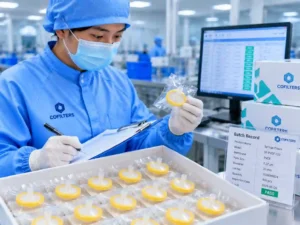
Can a few suspended particles compromise an HPLC analysis, damage production equipment, or cause an entire batch of liquid products to fail quality inspection?
Yes. In laboratories and industrial facilities, unwanted particles and other contaminants can affect much more than liquid clarity. They influence analytical reliability, equipment performance, product consistency, and operating costs. Understanding why we filter a solution helps us select suitable filtration methods, prevent avoidable failures, and maintain efficient processes.
In laboratories, filtration prepares samples and solvents for analytical techniques such as HPLC, helping prevent column blockage and unstable system pressure.
In industrial applications, filtration supports chemical processing, pharmaceutical manufacturing, food and beverage production, water treatment, and other liquid-handling operations.
Agilent’s Sample Preparation handbook identifies particulate removal as an important step before liquid chromatographic analysis because particles can shorten column life and affect instrument components. The U.S. Environmental Protection Agency (EPA) likewise distinguishes particulate filtration from processes that remove dissolved contaminants.
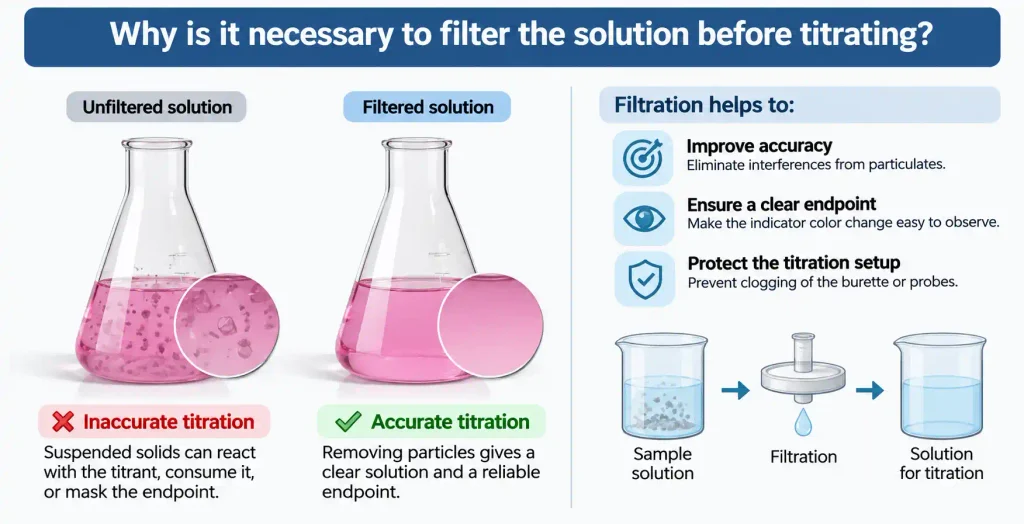
1. Why is it necessary to filter the solution before titrating?
Solution the filtration is a separation process that removes selected contaminants from a liquid by passing it through a suitable filtration medium.
During filtration, the liquid passes through a porous barrier or filter structure. The target particles or other retained materials remain on or within the medium. The clarified liquid, called the filtrate, continues to the next processing stage.
The retained material may be a contaminant, a valuable product, or a byproduct that requires separate treatment.
In practical applications, filtration performance depends on several factors:
- The size, concentration, and characteristics of the contaminants.
- The chemical and physical properties of the liquid.
- The filter medium, pore structure, and retention rating.
- The operating pressure, temperature, flow rate, and filtration volume.
- The required purity or separation objective.
We must also distinguish between a true solution and a liquid mixture containing suspended matter.
A true solution is a homogeneous mixture in which the dissolved components are distributed at the molecular or ionic level. Conventional particle filtration does not normally remove these dissolved species.
For example, a laboratory filter may remove suspended calcium carbonate particles from water. However, it will not remove dissolved sodium chloride simply because the membrane has small pores.
The same principle applies to industrial liquids. A filter can capture resin gels or catalyst particles, but removing dissolved chemical impurities may require adsorption, ion exchange, nanofiltration, reverse osmosis, or another separation technology.
The EPA explains that sediment and conventional microporous filtration remove suspended solids but do not remove dissolved solids. This distinction is essential when selecting a water filter solution or an industrial filtration solution.
Common Filtration Methods
We use several filtration approaches depending on the application.
Gravity filtration uses gravity to move liquid through filter paper or another medium. It is suitable for simple separations that do not require high throughput.
Vacuum filtration uses reduced pressure downstream of the medium. It is common in laboratories where faster solid-liquid separation is needed.
Pressure filtration uses positive pressure to force liquid through a filter. Industrial filtration systems often apply this principle to continuous or batch operations.
Depth filtration captures particles throughout the internal structure of a porous medium. It is useful when the liquid contains a range of particle sizes or relatively high solids loading.
Membrane filtration uses a membrane with defined separation characteristics. Its applications range from laboratory sample preparation to high-purity manufacturing.
Crossflow filtration moves the feed tangentially across the membrane surface. This arrangement can reduce the rate of surface cake accumulation and supports certain concentration and purification processes.
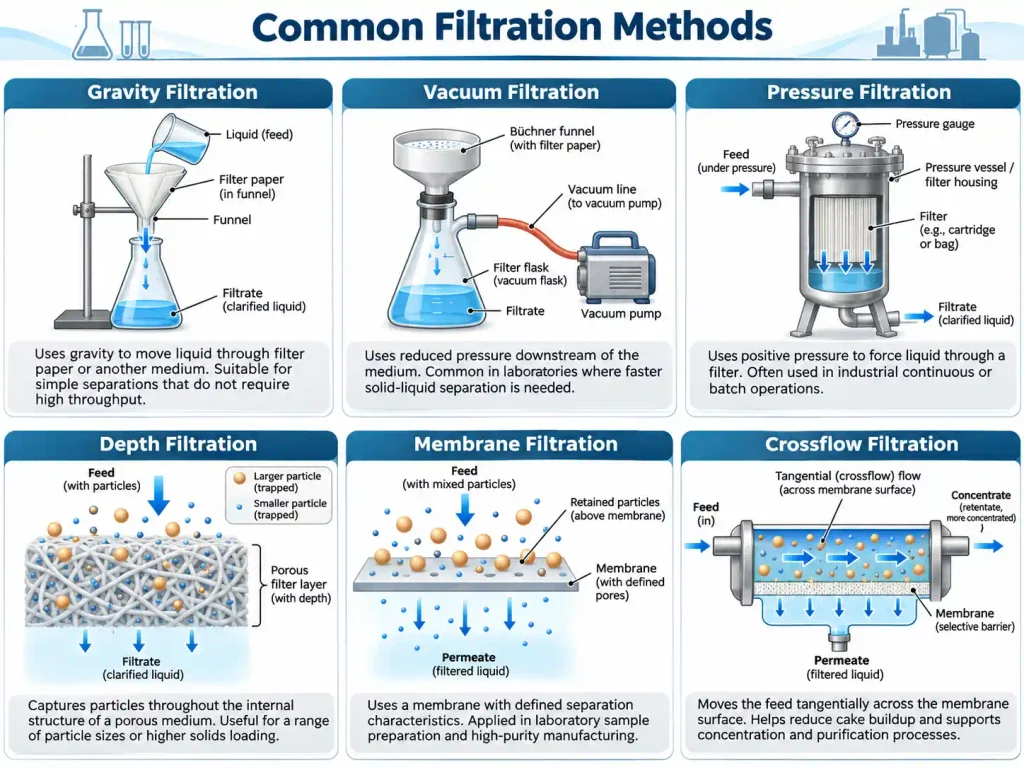
These categories describe different aspects of filtration. Gravity, vacuum, and pressure identify the driving force. Depth and membrane filtration describe media structures or retention mechanisms, while crossflow describes the fluid-flow arrangement.
Understanding this distinction helps us compare systems correctly rather than treating every filtration method as a direct alternative.
Table 1. Comparison of Common Filtration Methods
| Filtration Method | Main Operating Principle | Typical Application | Key Consideration |
|---|---|---|---|
| Gravity filtration | Gravity-driven liquid flow | Routine laboratory separation | Filtration rate |
| Vacuum filtration | Reduced downstream pressure | Crystal collection, laboratory clarification | Flask safety, solvent vapor control |
| Pressure filtration | Positive pressure differential | Industrial liquids, chemical processing | Pressure rating, filtration area |
| Depth filtration | Retention within porous media | High-solids clarification, prefiltration | Dirt-holding capacity |
| Membrane filtration | Selective retention by membrane characteristics | HPLC, pharmaceutical, high-purity liquids | Retention, compatibility, extractables |
| Crossflow filtration | Tangential flow along a membrane | Concentration, membrane separation | Fouling control, recirculation energy |
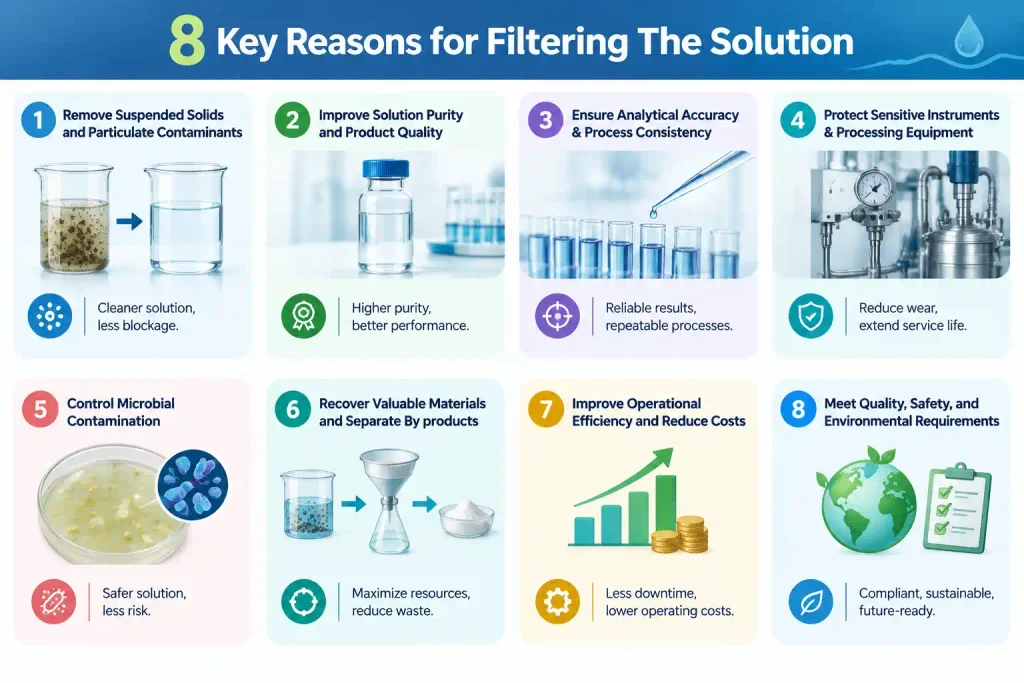
2. 8 Key Reasons for Filtering a Solution
2.1 Remove Suspended Solids and Particulate Contaminants
The most fundamental reason for filtration is to remove unwanted solid particles from liquids.
These particles can originate from raw materials, chemical reactions, storage containers, production equipment, or the surrounding environment.
Common examples include undissolved salts, precipitates, dust, corrosion particles, catalyst residues, and solid manufacturing by products.
Even when a liquid appears visually clear, it may still contain microscopic particles capable of affecting downstream operations.
Laboratory example: Precipitate removal
In chemical laboratories, we often use a laboratory filter to separate precipitates after a reaction.
Consider a reaction that produces an insoluble solid. The mixture may contain the desired dissolved compound, excess reagents, and solid reaction products.
If the objective is to recover the dissolved compound, filtration can remove the unwanted solid phase.
If the solid is the desired product, we collect the filter cake instead.
The correct procedure depends on which component we need to retain.
This principle is particularly important in titration. Removing undissolved solids may improve accuracy when those solids interfere with the analytical method. However, filtration can also introduce errors if the target analyte becomes trapped in the filter cake or changes its equilibrium during separation.
We therefore follow the validated analytical procedure rather than assuming every solution should be filtered before titration.
Industrial example: Chemical feedstock filtration
During chemical production, raw materials may contain debris, crystallized substances, or corrosion particles introduced during transportation and storage.
A chemical processing solvent filtration stage can capture these solids before the liquid enters reactors, pumps, or precision equipment.
The main benefit is straightforward: cleaner feed liquids reduce the amount of unwanted material entering critical process stages.
2.2 Improve Solution Purity and Product Quality
Filtration is an important purification step when the quality requirement involves particulate cleanliness, clarification, or the removal of specific retained contaminants.
In laboratories, sample purity can influence the success of downstream analysis and synthesis.
In industrial manufacturing, particulate contamination may create visible defects, affect product appearance, or interfere with later processing.
Laboratory example: Chemical synthesis
After a synthesis reaction, a mixture may contain unwanted solid byproducts or residual filtration aids.
A chemistry filter can separate these materials from the liquid product.
For procedures that require a hot liquid to remain dissolved during separation, hot vacuum filtration or hot gravity filtration may be appropriate, depending on the method and equipment.
Temperature control is important. If the target compound crystallizes prematurely, it may remain on the filter and reduce product recovery.
Industrial example: Coatings and specialty chemicals
During coatings production, liquids may contain oversized pigment agglomerates, resin gels, or foreign particles.
These contaminants can create surface defects, block spray nozzles, or reduce product consistency.
A correctly selected bag filter or filter cartridge can remove targeted particles before filling or application.
However, the filtration rating must be matched to the product. Excessively fine filtration may remove functional solids that contribute to the coating’s intended properties.
The objective is not to remove every particle. It is to remove unwanted material while preserving the formulation.
The same principle applies to beverages, liquid chemicals, and other formulated products.
2.3 Ensure Analytical Accuracy & Process Consistency
Particles do not only affect appearance. They can also influence measurements and process stability.
For analytical testing, suspended matter may scatter light, interfere with sample introduction, cause inconsistent aliquots, or contaminate instrument components.
For industrial processes, changes in particulate loading can contribute to inconsistent feed quality and unpredictable filter performance.
Laboratory example: HPLC sample filtration
High-performance liquid chromatography depends on controlled liquid flow through a packed column.
A sample containing suspended particles can block the inlet frit or create additional flow resistance.
This problem may increase backpressure and eventually interrupt analysis.
A published technical investigation from Merck evaluated syringe filter particle retention and monitored UHPLC backpressure during repeated injections.
The results illustrate why filtration performance matters beyond the stated pore size.
The study used a 0.05% (v/v) suspension of 0.5 μm polystyrene beads and an 8,000 psi cutoff. These results apply to the tested filter products and conditions; they are not universal filter-performance ratings.
The study also reported approximately 98–100% retention of the tested particles by the evaluated 0.45 μm PTFE filters, compared with 48.2 ± 4.3% for the tested regenerated cellulose filter.
This comparison shows that filters with the same nominal pore size may produce substantially different results.
For HPLC sample filtration, we must consider actual particle retention, membrane chemistry, analyte compatibility, and filter construction.
Industrial example: Consistent process feed
A chemical manufacturer may use fine filtration before a precision mixing, dosing, or filling operation.
When particulate contamination varies between batches, the downstream process may require additional cleaning or experience inconsistent performance.
A well-designed filtration step helps maintain a defined particulate specification. It does not, by itself, guarantee uniform chemical concentration or identical product quality.
2.4 Protect Sensitive Instruments & Processing Equipment
Unwanted particles can damage equipment or create avoidable maintenance problems.
This applies to laboratory instruments and industrial processing systems.
Laboratory example: HPLC column protection
HPLC equipment contains narrow fluid pathways, precision valves, pump components, and columns with restricted flow passages.
Particulate contamination can clog inlet frits and shorten the useful life of analytical components.
Agilent recommends filtering samples and suitable aqueous buffers for its specified HPLC system. Its 1290 Infinity guidance includes a recommendation for an appropriate 0.2 μm filter in that application.
A properly selected solvent filter HPLC setup helps prevent particles from entering the fluid path.
A solvent inlet filter can provide additional protection at the reservoir or pump inlet. However, it cannot replace appropriate sample preparation or remove every contaminant generated elsewhere in the system.
Industrial example: Pumps, valves, and spray systems
Particles in process liquids can obstruct small passages, damage sealing surfaces, or accelerate component wear.
The consequences may include unstable flow, poor spray patterns, greater maintenance requirements, and unplanned shutdowns.
Industrial cartridge filters and bag filters are commonly installed upstream of sensitive components.
When selecting this protection stage, we consider the contaminant load, allowable pressure drop, flow capacity, and maintenance access.
A filter that protects equipment but becomes blocked too quickly may create a new operational problem. Suitable surface area and a realistic replacement schedule are therefore essential.
2.5 Control Microbial Contamination
Some laboratory and industrial processes require control of bacteria and other microorganisms.
Membrane filtration can support microbial control when the filter has suitable and demonstrated retention performance.
Laboratory example: Heat-sensitive solutions
Laboratories may filter suitable buffers, culture media components, or other heat-sensitive liquids that cannot tolerate conventional thermal sterilization.
A properly selected sterilizing-grade membrane can remove relevant microorganisms under validated conditions.
However, the presence of a 0.22 μm label alone does not establish that a filtration process produces a sterile liquid.
The U.S. FDA explains that sterilizing-grade filtration requires appropriate microbial retention validation. Its guidance also discusses microbial challenge testing, filter integrity, and process conditions.
Industrial example: Pharmaceutical production
Pharmaceutical manufacturing may use sequential filtration stages.
A coarse or depth prefilter removes larger particles and reduces the burden on downstream filters.
A final sterilizing-grade membrane may then provide the required bacterial retention where filtration sterilization is appropriate.
This arrangement can improve the practicality of the process, but manufacturers must establish product-specific validation and contamination controls.
In food and beverage manufacturing, membrane filtration can also help reduce microbial loads. The appropriate process depends on the beverage, target organisms, and required shelf-life or safety criteria.
We should not equate ordinary clarification with sterilization.
2.6 Recover Valuable Materials and Separate By products
Filtration is not always performed to discard unwanted solids.
In many applications, the retained material is the valuable product.
Laboratory example: Crystal recovery
In organic chemistry, a reaction may produce crystalline material that must be separated from the mother liquor.
A Büchner funnel or Hirsch funnel filtration arrangement may be used, depending on sample quantity, crystal characteristics, and laboratory procedure.
A Hirsch funnel filtration setup is particularly useful for collecting relatively small quantities of crystals under vacuum.
We may also use suitable washing solvents to remove residual mother liquor from the filter cake.
The process requires careful solvent selection because excessive solubility can reduce product recovery.
Industrial example: Catalyst recovery
Chemical and petrochemical processes may use solid catalysts that remain suspended in the reaction mixture.
Separating these catalysts can reduce product contamination and, where recovery is technically and economically feasible, allow further processing or reuse.
Pall lists catalyst and salt recovery among its established chemical filtration applications.
In catalyst recovery, we must evaluate particle size, catalyst value, chemical resistance, filtration capacity, and cleaning methods.
The economic value of recovered material can influence equipment selection as much as the required filtrate purity.
2.7 Improve Operational Efficiency and Reduce Costs
Filtration can reduce operational costs by preventing contamination-related problems before they reach more expensive process stages.
However, filtration also consumes resources.
Filters create pressure drop, require replacement or cleaning, and may retain valuable liquid. We therefore evaluate net process benefit rather than treating filtration as a cost-free improvement.
Laboratory example: Reduced repeat analysis
A blocked HPLC column can interrupt testing, require troubleshooting, and delay sample analysis.
Preventing particulate contamination reduces one common source of these disruptions.
The published Merck comparison demonstrates how filter retention can influence column backpressure under controlled test conditions. It does not establish a universal percentage reduction in laboratory operating costs.
Industrial example: Reduced production downtime
An industrial facility may install a prefilter to protect a high-value downstream membrane or processing unit.
The prefilter captures contaminants that could otherwise accumulate in the more expensive component.
This can reduce maintenance frequency when the prefilter is sized correctly and replaced before excessive pressure loss develops.
To evaluate savings, we consider total filtration cost:
Total filtration cost = filter media cost + energy cost + maintenance and replacement cost + product loss + contamination-related downtime cost.
This approach is more useful than comparing cartridge prices alone.
An inexpensive filter with low dirt-holding capacity may require frequent replacement. A more expensive filter may offer better economics if it provides longer service life under comparable operating conditions.
2.8 Meet Quality, Safety, and Environmental Requirements
Filtration supports quality control and environmental management by helping facilities achieve defined contaminant limits.
The relevant requirements depend on the industry, product, location, and intended use.
Laboratory example: Validated analytical procedures
Some analytical methods specify sample preparation steps, including filtration.
When filtration is part of a validated method, laboratories must use suitable materials and follow the prescribed procedure.
Changing the membrane type or pore size without evaluating the effect may alter analyte recovery or introduce interfering compounds.
Industrial example: Wastewater pretreatment
Industrial wastewater may contain suspended particles that interfere with pumps, membranes, or downstream treatment systems.
Appropriate filtration can reduce suspended solids and improve the suitability of water for subsequent processing.
For reuse applications, filtration may be combined with other technologies to achieve specific water-quality targets.
The EPA distinguishes microfiltration and ultrafiltration from reverse osmosis and nanofiltration because these processes remove different classes of contaminants.
Filtration supports compliance only when the complete treatment process satisfies the applicable requirements.
A single filter cannot be assumed to remove every regulated pollutant.
3. Solution Filtration Applications
The reasons for filtration remain similar across industries, but the operating conditions can differ substantially.
A laboratory may filter 10 mL of sample before analysis. A chemical plant may process several cubic meters of liquid per hour. Both applications require appropriate separation performance, but their equipment, maintenance procedures, and operating priorities are different.
Table 2. Laboratory and Industrial Filtration Applications
| Industry | Typical Liquids | Main Filtration Objective | Common Filter Equipment |
|---|---|---|---|
| Analytical laboratories | Samples, solvents, buffers | Particle removal, column protection | Syringe filters, vacuum filter assemblies |
| Chemical processing | Solvents, acids, resins | Feedstock cleaning, catalyst separation | Bag filters, cartridge filters |
| Pharmaceuticals | Buffers, drug solutions | Clarification, microbial control | Membrane cartridges, depth filters |
| Food and beverage | Juice, beer, syrups | Clarification, selected microbial reduction | Depth filters, membrane filters |
| Water treatment | Process water, wastewater | Suspended solids removal, pretreatment | Sediment filters, MF/UF systems |
| Petrochemicals | Amines, glycols, fuels | Contaminant control, equipment protection | Cartridge filters, coalescers |
| Semiconductor | High-purity solvents, process chemicals | Fine particle and contamination control | High-purity membrane filters |
| Coatings and inks | Paints, resins, inks | Gel and agglomerate removal | Bag filters, depth filters |
4. How to Choose the Right Filter for a Solution
Choosing the right filter requires evaluating contaminants, micron rating, chemical compatibility, operating conditions, and filtration equipment. Proper selection improves filtration efficiency, protects downstream equipment, and reduces operating costs.
4.1 Identify Contaminants and Filtration Objectives
Determine whether the solution contains suspended particles, precipitates, microorganisms, liquid droplets, or dissolved chemicals.
Different contaminants require different separation methods. Particle filters remove suspended solids, while coalescers separate dispersed liquid droplets. Dissolved substances may require specialized treatment.
Clearly define whether the objective is clarification, equipment protection, solid recovery, or high-purity filtration.

4.2 Choose the Appropriate Micron Rating
Select the pore size according to particle size and downstream requirements.
Nominal ratings indicate retention under specified conditions, while absolute ratings refer to defined retention criteria. Actual performance depends on the test method and manufacturer.
For laboratory applications, 0.45 μm filters are commonly used for HPLC, while 0.2 μm filters may be preferred for UHPLC, depending on instrument requirements.
Industrial filtration may require larger micron ratings to balance particle retention, flow rate, and service life.
Smaller pore sizes do not always provide better overall performance.
4.3 Verify Chemical Compatibility
Filter membranes and all wetted components must withstand the solution’s chemical composition, temperature, pressure, and contact duration.
Table 3. Common Filter Membrane Materials
| Material | Typical Applications | Key Considerations |
|---|---|---|
| PTFE | Organic solvents, aggressive chemicals | Broad chemical resistance; wetting requirements |
| PES | Aqueous solutions, bioprocessing | Good wettability; verify solvent compatibility |
| Nylon | Laboratory samples, selected solvents | Durable; potential analyte binding |
| PP | Industrial liquids, chemical prefiltration | Chemical resistance varies by solvent and temperature |
| PVDF | Chemical and biological filtration | Grade-specific compatibility and binding |
| Regenerated Cellulose | HPLC sample preparation | Low-binding options; verify chemical resistance |
Always verify supplier-specific compatibility data for the entire filter assembly, including housings, seals, and connectors.
4.4 Evaluate Operating Conditions
Consider flow rate, viscosity, pressure, temperature, filtration volume, and contaminant loading.
Laboratory filtration typically prioritizes low hold-up volume and sample recovery, while industrial systems require sufficient flow capacity and pressure resistance.
High particle loading may require larger filtration areas, staged filtration, or cleanable filters to prevent premature clogging.
4.5 Select Suitable Filtration Equipment
Match filtration equipment to the application scale and operating requirements.
- Syringe filters: Small-volume laboratory samples.
- Glass solvent filters: Laboratory solvent filtration and larger sample batches.
- Solvent filtration kits: Complete laboratory filtration setups.
- Industrial solvent filter systems: Continuous or high-volume filtration using pressure-rated housings and cartridge elements.
- Parallel filtration units: Increased capacity and maintenance flexibility.
The final selection should prioritize chemical compatibility, filtration efficiency, flow capacity, and operational safety rather than universal product claims.
5.Conclusion
Filtration plays an important role in both laboratory analysis and industrial manufacturing.
It removes unwanted particles, supports liquid purity, protects sensitive equipment, improves process consistency, and helps recover valuable materials. In selected applications, specialized membrane filtration also supports microbial control and defined quality requirements.
However, successful filtration depends on choosing the right technology. The filter medium, retention rating, chemical compatibility, flow capacity, and operating conditions must match the actual application.
At Cofilters, we recognize that reliable filtration begins with understanding the liquid and the separation objective. Whether the application involves laboratory samples, organic solvents, chemical processing, or industrial liquids, an appropriate filtration solution can help control contamination and maintain dependable operation.
Looking for a suitable filtration solution?
Cofilters supplies filtration products for a range of laboratory and industrial liquid applications. Contact our team to discuss your liquid characteristics, target contaminants, filtration accuracy, operating conditions, and equipment requirements.